Canadian Tax Calculator
Visually calculate your 2024, 2025, and 2026 personal Canadian taxes with detailed breakdowns and sankey diagrams.
tl;dr
Canadian income tax is two calculations added together: federal tax on the federal brackets and provincial tax on your province's brackets. You pay each bracket's rate only on the income that falls inside it, so no single rate applies to your whole income. Tax credits then reduce what you owe. Enter your income and province to see where every dollar goes.
About This Calculator
Canadian Tax Calculator
Enter your income and deductions below, then click Calculate Tax to see a detailed breakdown of your federal and provincial taxes.
Tax Calculator
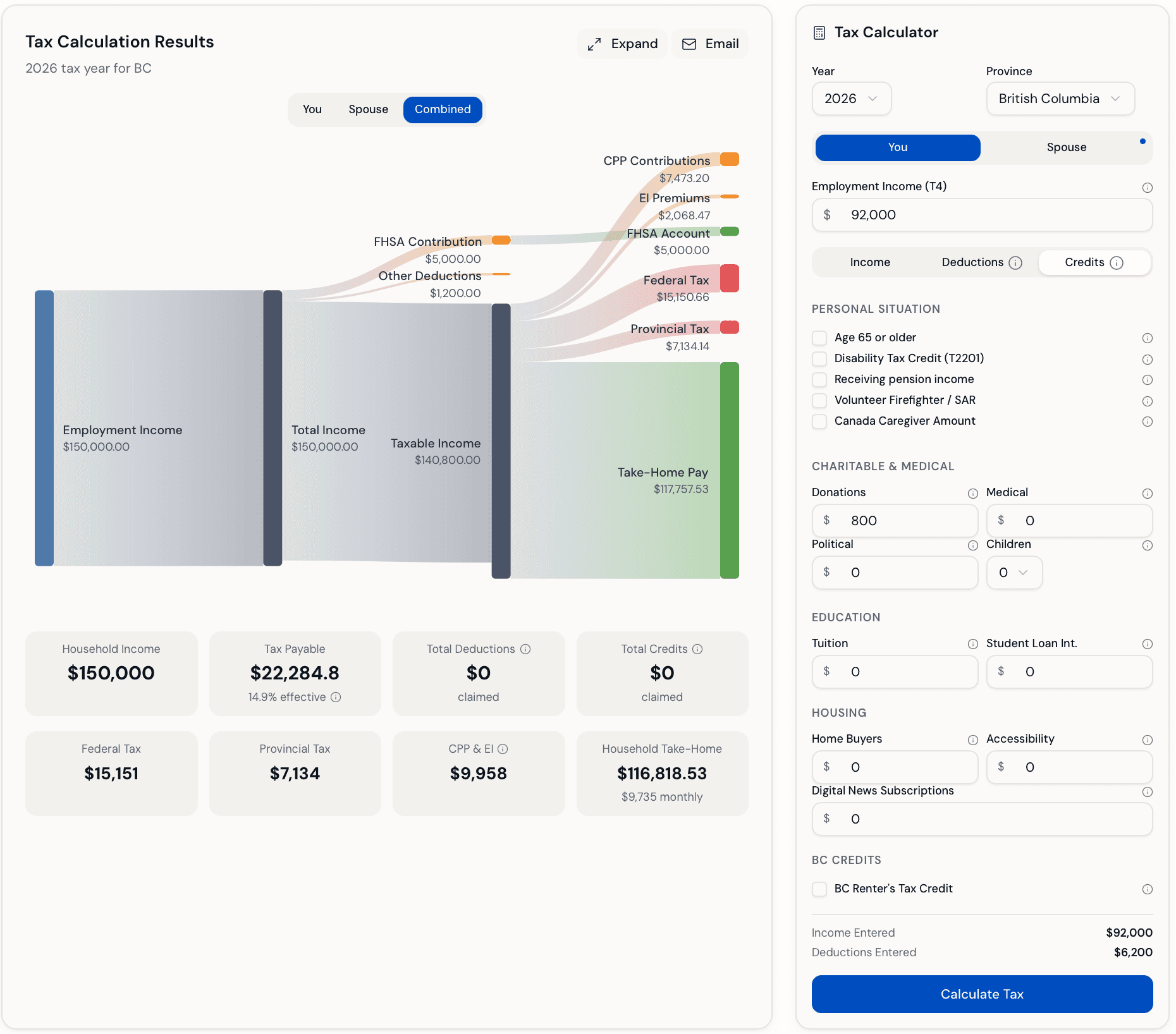
Example: A Couple in British Columbia
Sarah earns $92,000 as a teacher in Vancouver. She opened an FHSA this year and contributed $5,000 to save for a first home. She also pays $1,200 in union dues and donates $800 to charity. Her partner Mike earns $58,000 and contributes $3,000 to his RRSP. He had $2,500 in medical expenses this year.
Sarah's FHSA contribution lowers her taxable income while building toward a down payment, and Mike's RRSP does the same for him. The calculator applies the current federal and BC rates, CPP, CPP2, and EI, and credits for donations and medical expenses — enter your own numbers above to see your exact tax and take-home pay.
Compare Provincial Tax Rates
You might also be interested in...
Related calculators that complement your financial planning
Canada Child Benefit (CCB) Calculator
Federal CCB + Provincial Benefits
Calculate federal CCB plus provincial child benefits. See how RRSP/FHSA contributions increase benefits by reducing AFNI. All provinces included.
TFSA vs RRSP Calculator
Tax-Efficient Investment Strategy
Free TFSA vs RRSP calculator. Compare after-tax returns with refund reinvestment for Canadian savers. Find which account maximizes your retirement savings.
Canada-wide Tax Comparison
All Provinces & Territories
Compare take-home pay across all Canadian provinces and territories. Interactive map shows net income after taxes, CPP, and EI.
Why Understanding Your Tax Matters
Income tax is one of the biggest expenses in most Canadian households. Knowing how your bill is built — which income is taxed at which rate, and what each deduction or credit is worth — is what lets you lower it legally, through RRSP and FHSA contributions, pension income splitting, and claiming every credit you're entitled to.
How Your Tax Is Calculated
The calculator follows the same order as your tax return.
- 1. Add up total income: employment, self-employment, pension, investment and other income.
- 2. Subtract deductions such as RRSP and FHSA contributions and union dues to get net income and taxable income.
- 3. Calculate federal tax on the federal brackets and provincial tax on your province's brackets, separately.
- 4. Subtract non-refundable credits, starting with each government's basic personal amount.
- 5. Deduct CPP contributions and EI premiums to show your take-home pay.
Common Questions
How is income tax calculated in Canada?
Canadian income tax uses a progressive system with separate federal and provincial components. First, your total income is added up (employment, self-employment, dividends, capital gains, and so on). Deductions like RRSP contributions and union dues are then subtracted to get your taxable income. Federal and provincial tax are calculated separately using their own brackets, and tax credits are applied to reduce the amount owing. The calculator handles every step, including CPP, EI, and provincial-specific calculations.
What are tax brackets and how do they work?
Tax brackets are income ranges taxed at increasing rates. Canada uses a progressive system: you pay the higher rate only on the income that falls within each bracket, not on all of your income. Federal and provincial governments each set their own brackets with separate thresholds that don't line up, so your total tax is the two calculated independently and added together — there is no single combined schedule. The calculator and bracket tables show the rates that apply to you.
Which province has the lowest taxes in Canada?
Alberta consistently has among the lowest provincial income taxes, with low provincial rates and one of the highest Basic Personal Amounts in Canada. Among the territories, Nunavut has some of the lowest rates, though with a much higher cost of living. Use the provincial calculator to compare current rates side by side.
Which province has the highest taxes in Canada?
For top earners, provinces such as Quebec, British Columbia, Nova Scotia, and Newfoundland and Labrador have among the highest top marginal rates in Canada. These provinces often offset higher rates with more generous refundable credits for low- and middle-income residents. The calculator shows the current rates for each province.
What is the Basic Personal Amount?
The Basic Personal Amount (BPA) is the income you can earn before paying income tax. There are both federal and provincial BPAs, and together they reduce your tax. The amounts differ by jurisdiction and are indexed over time — the calculator and the provincial bracket tables show the current figures. A higher BPA means lower overall tax, especially for low- and middle-income earners.
What tax credits can I claim in Canada?
Canadian taxpayers can claim numerous federal and provincial tax credits. Federal credits include the Basic Personal Amount, Canada Employment Amount, Age Amount, Pension Income Amount, Disability Tax Credit, Medical Expense Credit, Charitable Donations Credit, and refundable credits like the Canada Workers Benefit and the Canada Groceries and Essentials Benefit (formerly the GST/HST credit). Each province offers additional credits — some provide refundable credits for renters, seniors, low-income workers, children's activities, and more. The calculator includes all major federal and provincial credits.
What's the difference between a tax credit and a tax deduction?
Tax deductions (like RRSP contributions) reduce your taxable income before tax is calculated, saving tax at your marginal rate. Tax credits reduce the tax you owe after it's calculated. Most non-refundable credits are applied at the lowest tax rate, while a deduction saves at your marginal rate — so a deduction is generally worth more to higher earners. Refundable credits can produce a refund even if you owe no tax. The calculator applies both for you.
How do RRSP contributions reduce my taxes?
RRSP contributions reduce your taxable income dollar-for-dollar, saving tax at your marginal rate — the higher your rate, the larger the saving. The calculator shows your estimated RRSP tax savings for your income and province. Your contribution room is a percentage of your previous year's earned income up to an annual maximum, plus any unused room; check your CRA notice of assessment for your exact limit.
What is the difference between federal and provincial tax?
Federal tax applies to everyone using the same national brackets, while provincial tax varies by province with its own rates, brackets, and credits. Both are calculated on the same taxable income but on separate bracket systems whose thresholds don't line up — your total is the two added together, never a single combined rate. Quebec is unique: residents receive the Quebec Abatement (a reduction in federal tax) and file a separate provincial return.
How are dividends taxed in Canada?
Dividends receive preferential treatment through the dividend tax credit. The dividend is first "grossed up," then you claim a credit that offsets the gross-up and more — resulting in lower effective rates than employment income at many income levels. Eligible dividends (from public corporations) receive a larger gross-up and credit than non-eligible dividends (typically from small private corporations). The calculator handles the gross-up and credit for both federal and provincial tax.
How are capital gains taxed?
Only part of a capital gain — the taxable portion set by the federal inclusion rate — is added to your taxable income, then taxed at your marginal rate. That makes capital gains more tax-efficient than employment income. The calculator applies the current inclusion rate automatically when you enter a gain.
What is the difference between eligible and non-eligible dividends?
Eligible dividends come from public corporations or CCPCs paying the higher corporate tax rate; they receive a larger gross-up and a larger dividend tax credit. Non-eligible dividends come from CCPCs earning income taxed at the small-business rate; they receive a smaller gross-up and credit. Eligible dividends are more tax-efficient at most income levels. The calculator handles both types and shows the different treatment.
Do I have to pay CPP and EI on all income?
CPP applies to employment and self-employment income, and EI to employment income — not to investment income, dividends, or capital gains. Contributions apply between an annual floor and ceiling, with a second, higher CPP band (CPP2) on earnings above the first ceiling. Quebec has its own QPP and QPIP with different rates. The calculator computes all of these automatically from your employment income.
What types of income does this calculator support?
The calculator handles all major personal income types: employment income (T4), self-employment income, eligible and non-eligible dividends, capital gains, interest income, and other income. It also supports spouse/couple calculations with a combined household view, RRSP contributions, and all major federal and provincial tax credits and deductions.
How accurate is this tax calculator?
The calculator uses official federal and provincial tax rates, brackets, and credit amounts from the Canada Revenue Agency and provincial tax authorities, kept current in the engine. It includes CPP, CPP2, EI, dividend tax credits, capital-gains treatment, RRSP deductions, and the major federal and provincial credits. It's designed for estimation; complex situations involving foreign income, business income with CCA, or specialized credits may need professional advice.
Lowering Your Tax Bill
- ✓Contribute to your RRSP or FHSA — the deduction saves tax at your marginal rate.
- ✓Claim every credit you qualify for: medical expenses, donations, tuition and caregiver amounts.
- ✓In a couple, pension income splitting and spousal RRSPs can move income to the lower earner.
- ✓Thinking about a move? Compare take-home pay across provinces first.
- ✓Check your marginal rate before taking a bonus or extra income.