Does your family know where everything is?
You have a will. Maybe. You've named beneficiaries on some accounts. Probably. Your spouse knows where the important documents are. Hopefully. If any of that made you uncomfortable, this page is for you.
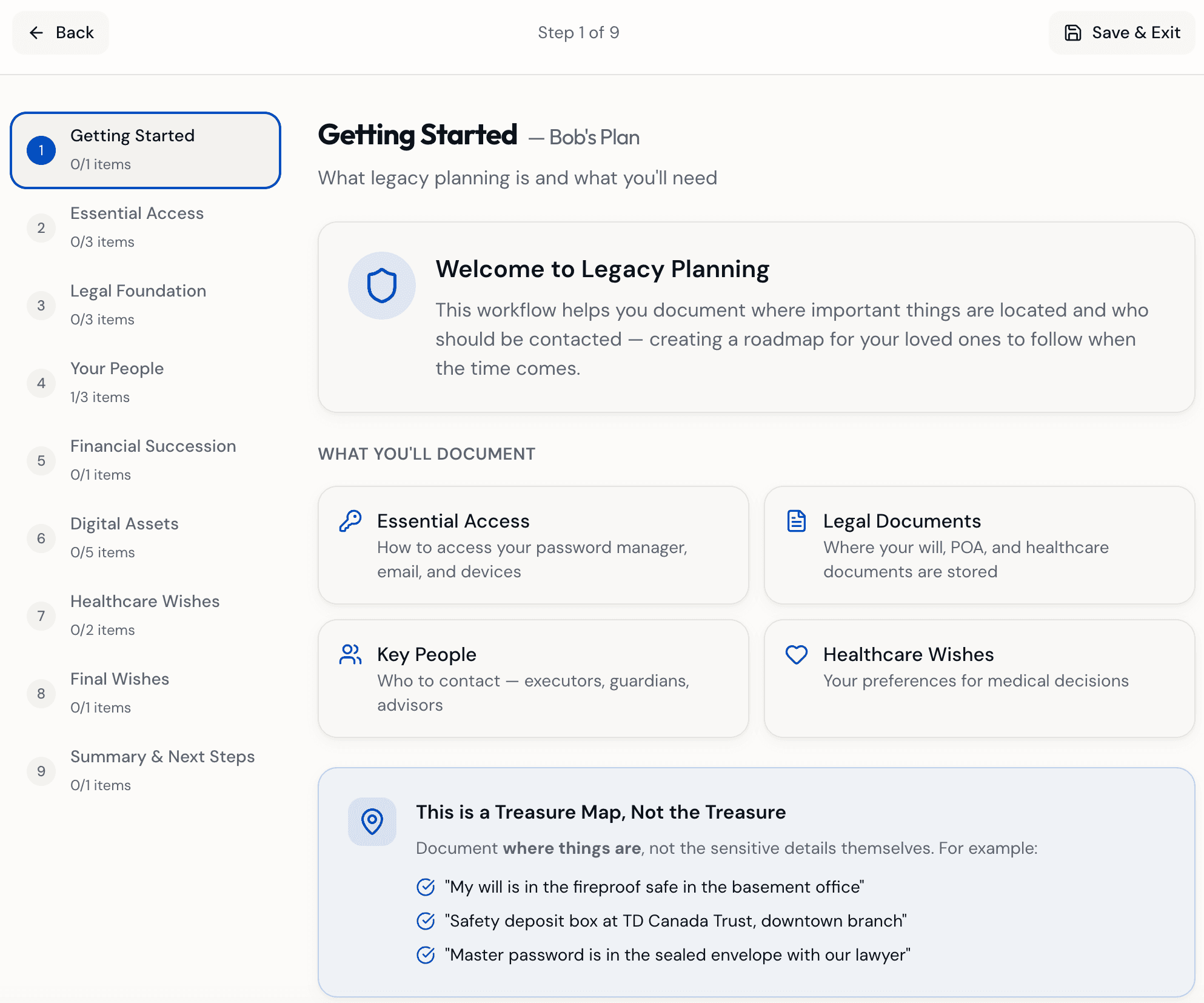
A step-by-step roadmap, not a checklist you’ll ignore
Legacy planning feels overwhelming because people try to do it all at once. We break it into manageable steps that you work through at your own pace:
- Legal documents: Will, power of attorney for property, power of attorney for personal care, healthcare directive, marriage contract. Track whether each exists, when it was last updated, and where it's stored.
- Key contacts: Executor, trustee, guardian for minor children, lawyer, accountant. The people your family will need to reach.
- Beneficiary designations: For every registered account — RRSP, TFSA, RRIF, life insurance. A named beneficiary bypasses probate. A missing one doesn't.
- Digital assets: Bank accounts, brokerage logins, email, social media, crypto wallets, devices. The stuff that's invisible until someone needs to find it.
- Healthcare wishes: Organ donation preferences, funeral arrangements, end-of-life care directives.
- Pets: Who takes care of them, vet information, care instructions.
You don't have to do it all today. But every step you complete is one less thing your family has to figure out under the worst possible circumstances.
The things people forget
Most people think “estate planning” means having a will. It's a start, but it's not enough. Here's what gets missed:
Beneficiary designations override your will. If your RRSP names your ex-spouse as beneficiary and your will says “everything to my current spouse,” the RRSP goes to your ex. The will doesn't matter for that account. The workflow flags every account that needs a beneficiary review.
Power of attorney is for while you're alive. A will only applies after death. If you're incapacitated — stroke, accident, dementia — your family can't access your accounts or make decisions without a POA. And you need two kinds: one for property (financial decisions) and one for personal care (healthcare decisions).
Digital assets are invisible. If nobody knows your email password, they can't reset the passwords to anything else. If nobody knows about your crypto wallet, it's gone. The workflow captures all of it.
The best time to do this was years ago. The second best time is right now.
Part of a bigger protection plan
Legacy planning is one of three tools that protect your family. Together they answer every question that matters:
Insurance gap analysis: Does my family have enough money to live on? The real number, not a rule of thumb.
Estate planning: What do my heirs actually receive after taxes and probate? The real math.
Legacy planning (this page): Does my family know where everything is and what to do? The roadmap.
Money, math, and a map. That's what protection looks like.
$99/year Free for 2026.
Calculators and learning content are free. The planning app is free through 2026, then $99/year per household.
Reserve Your Place In Line