Where does all your money actually go?
You make decent money. You pay your bills. But at the end of the month, where did it all go? And are you saving enough? Most Canadians can tell you their salary. Very few can tell you what happens between the paycheque and the end of the month.
See how money moves through your household
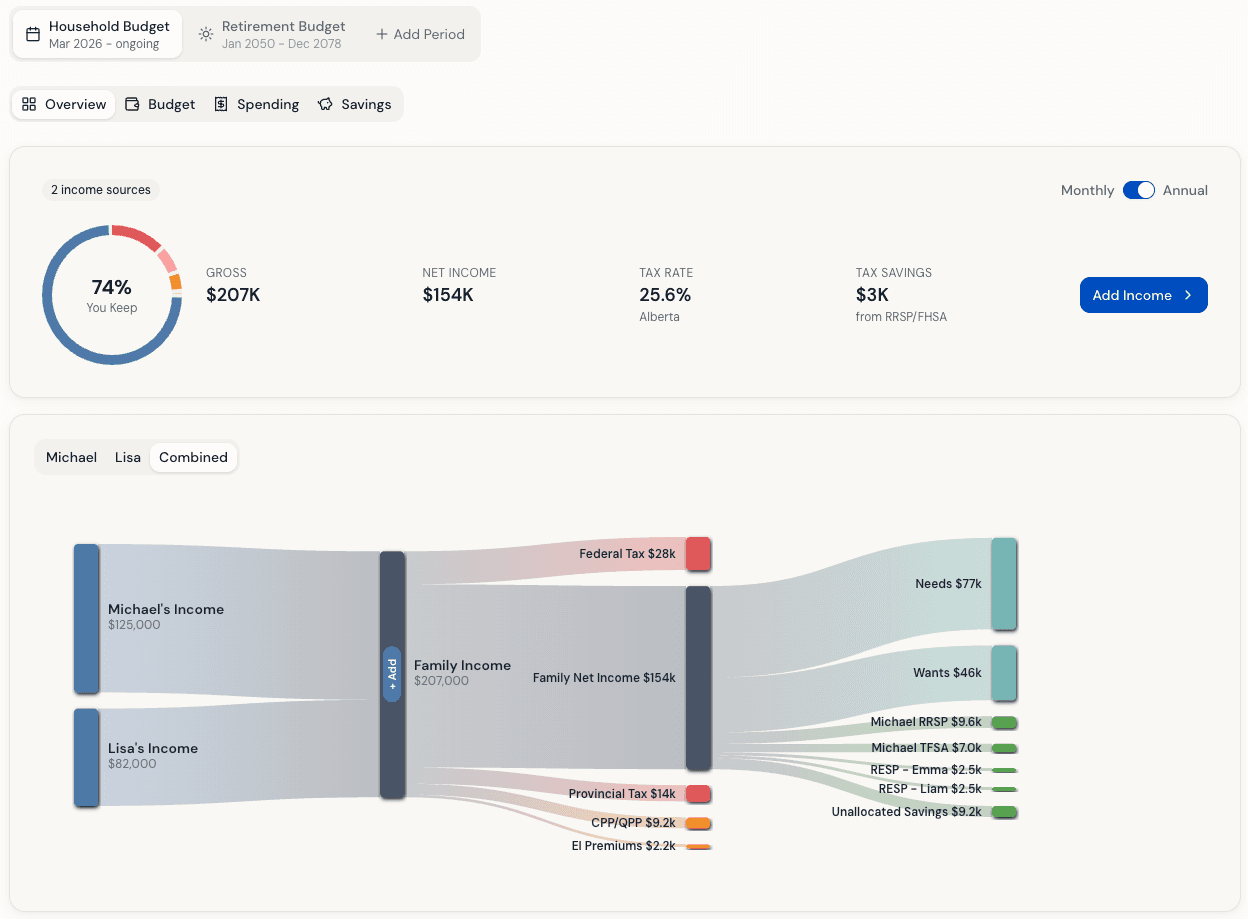
Most budget apps show you a pie chart of spending categories. That's the end of the story, not the beginning. You need to see the whole flow: gross income through taxes and deductions, through employer benefits and CPP/EI contributions, into net income, then out to bills, spending, and savings.
The cash flow view shows your entire household as a Sankey diagram — a visual map of where every dollar goes. Monthly or annual. Individual or combined with your partner. It shows your effective tax rate, your savings rate, and exactly where the leaks are.
This isn't an approximation. The tax numbers are calculated from your actual income and province — the same tax math that powers your retirement projections. So what you see is what you actually take home.
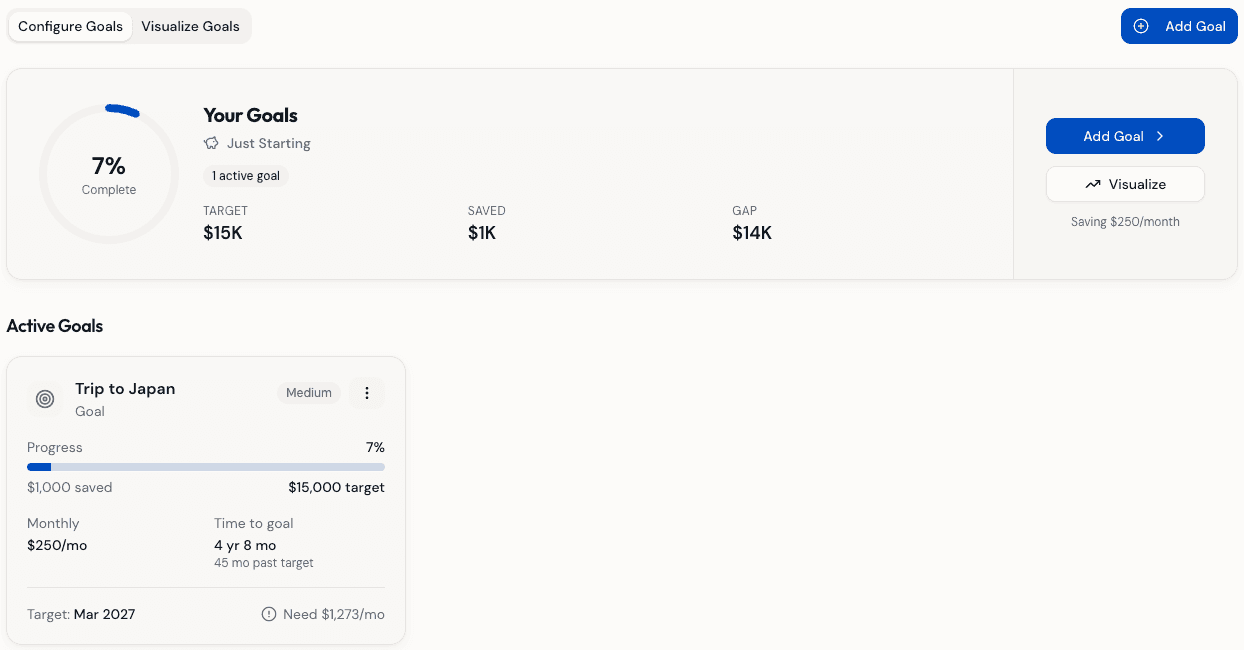
People who monitor their financial goals are significantly more likely to achieve them. That's not a hunch — it's backed by a meta-analysis of 138 studies.
Pick a budget strategy that fits your brain
Not everyone budgets the same way. The best budget is the one you'll actually stick with. Choose the approach that matches how you think:
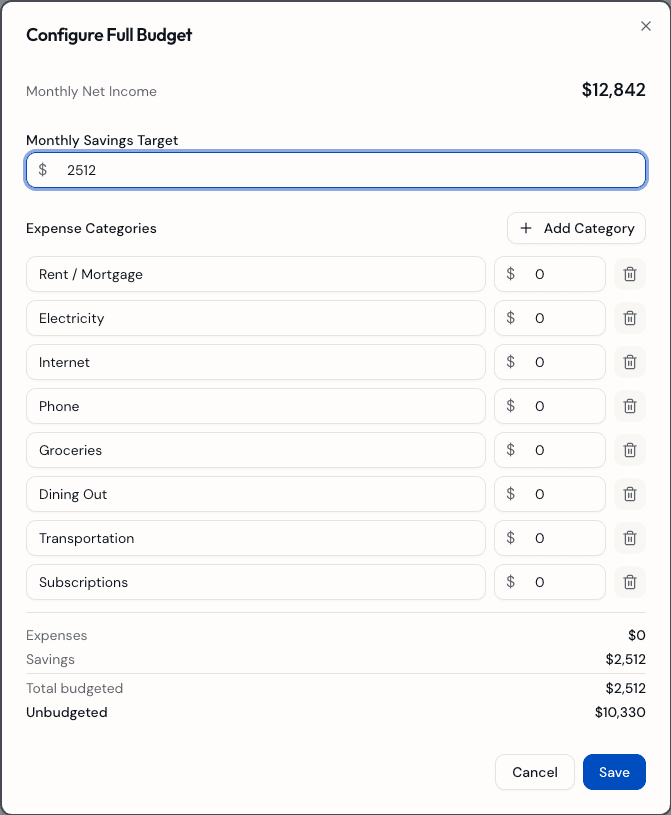
- Reverse budget: Set a savings target and spend the rest. The simplest approach — pay yourself first, automate it, and stop worrying about every latte. If you're hitting your savings number, the details don't matter.
- Full itemized budget: Track every category against a target. For people who want to know exactly where every dollar goes. Monthly actuals vs. plan, category by category.
- 50/30/20 rule: 50% needs, 30% wants, 20% savings. A balanced middle ground that gives you structure without micromanaging.
Then track your actual spending against your plan, month by month. See where you're on track and where you're drifting. Log expenses on your phone at the grocery store or on your laptop at the end of the week.
Canadian households who plan save 10.75% annually vs. 6.7% for those who don't. That gap compounds into hundreds of thousands over a career.
Your budget changes when your life does
Your spending at 35 doesn't look like your spending at 65. Mortgage payments disappear. Employment income stops. CPP and OAS start. Healthcare costs rise. You shouldn't have one budget for your entire life.
Create separate budget periods for different life stages — working years, transition to retirement, full retirement. Each period has its own income sources, expense categories, and savings targets. Taxes and inflation are recalculated automatically for each period.
This connects directly to your retirement plan. Your budget feeds the lifecycle simulation, and the simulation validates whether your savings targets are enough to fund the retirement you're planning for.
Budgeting isn't about restriction. It's about knowing you're on track.
Explore more
$99/year Free for 2026.
Calculators and learning content are free. The planning app is free through 2026, then $99/year per household.
Reserve Your Place In Line