Will the RESP actually cover it?
You've been contributing. The government adds CESG grants. It grows. But when your kid starts university, will it be enough? And how do you withdraw it without getting hammered on taxes? Most parents don't think about the withdrawal strategy until it's too late.
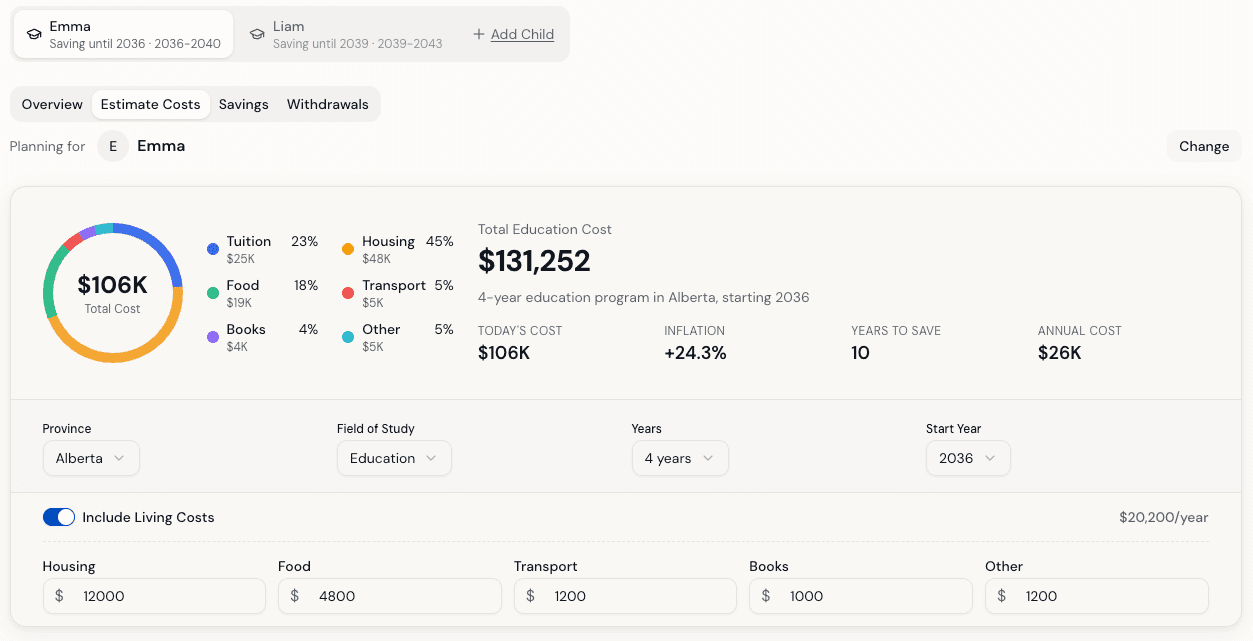
How much will university actually cost?
“University costs about $20K a year” is a national average that helps nobody. The real cost depends on the province, the field of study, whether your kid lives at home or moves away, and how much tuition inflates between now and enrollment.
The RESP planning tool estimates real education costs by province and program — tuition, books, living expenses, transportation. Then it tests your RESP across hundreds of market scenarios to see whether your savings will actually cover the bill when the time comes.
If there's a gap, you'll know years before it matters — and exactly how much extra per month would close it.
The average Canadian RESP runs out before graduation. Yours doesn't have to.
The withdrawal strategy nobody tells you about
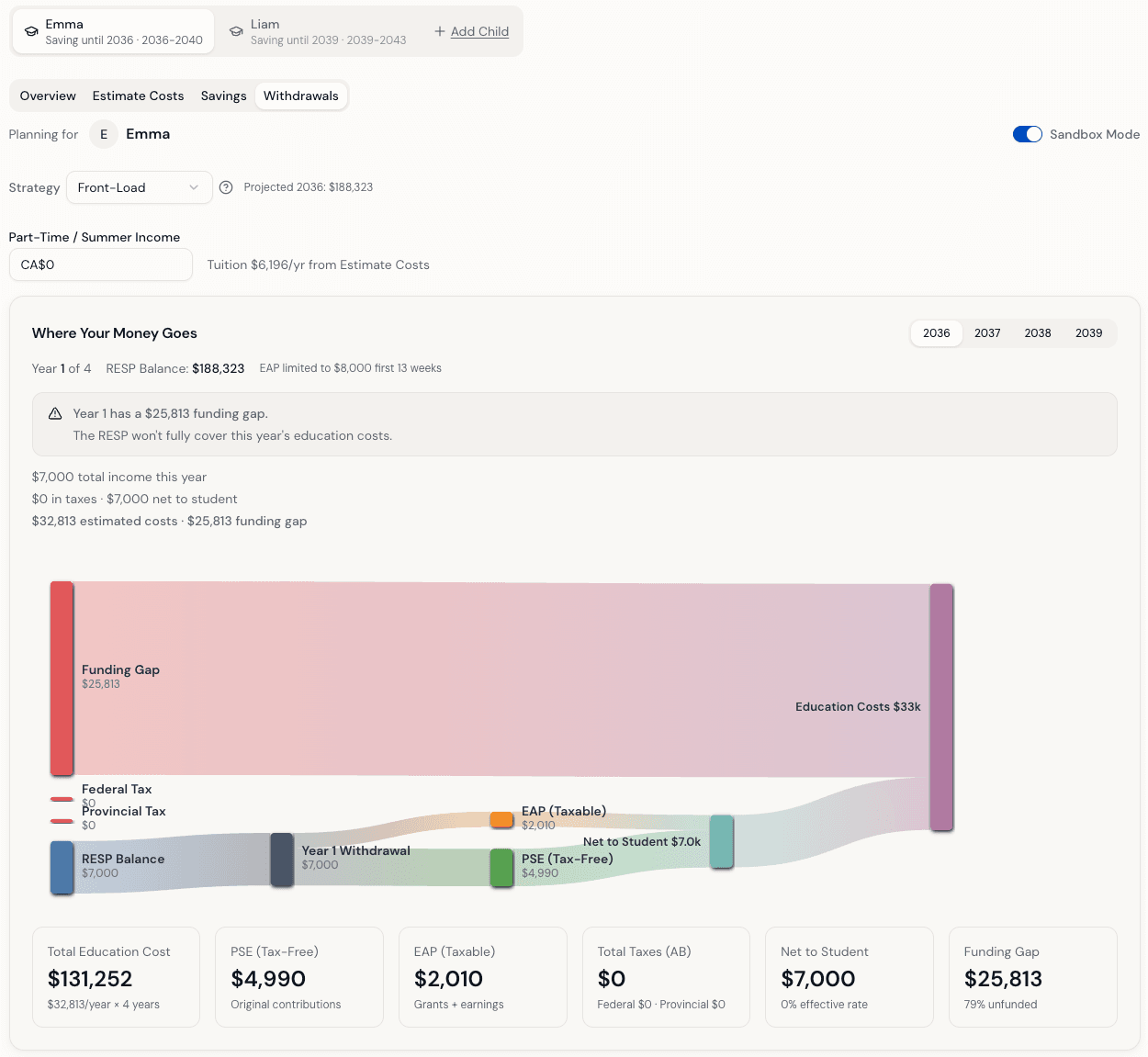
RESP withdrawals have two components: PSE withdrawals (your original contributions — tax-free) and EAPs (the grants and investment growth — taxable to the student). How you split them matters.
If your student withdraws too much EAP in one year, they owe taxes. If they withdraw too little, you leave money on the table. The sweet spot is keeping their total income under the basic personal amount so they pay zero tax on the growth.
Compare three withdrawal strategies side by side:
- Even distribution: Spread EAPs evenly across all years of study. Simple and predictable.
- Front-loaded: Pull more EAP in early years when the student has less other income (no co-op, no summer job yet).
- Tax-optimized: Maximize EAP withdrawals each year while keeping total income below the basic personal amount. The most tax-efficient approach.
We calculate the student's actual tax owing under each strategy. Not estimates. Real math.
You spent years contributing. Don't lose thousands to taxes on the way out.
Maximize every dollar of free government money
The Canada Education Savings Grant (CESG) matches 20% of your contributions up to $500/year per child, with a $7,200 lifetime cap. That's free money — but timing matters. If you miss a year, you can carry forward the unused room and get up to $1,000 in grants the following year. Miss too many years and the carry-forward limit caps you.
Provincial grants add more on top. In BC, the BC Training and Education Savings Grant (BCTESG) adds a one-time $1,200 when your child turns 6. In Quebec, the QESI provides an additional provincial match. The Canada Learning Bond (CLB) provides up to $2,000 for lower-income families with no contribution required.
The tool models all applicable grants based on your province, tracks your contribution room, and shows you the optimal contribution schedule to maximize every dollar of free money over your child's lifetime.
The government is giving you money. Make sure you're collecting all of it.
$99/year Free for 2026.
Calculators and learning content are free. The planning app is free through 2026, then $99/year per household.
Reserve Your Place In Line