Should I put this in my RRSP or my TFSA?
That's the most common Canadian tax question — and the answer is never simple. It depends on your marginal rate today, your expected rate in retirement, your province, your spouse's income, and a dozen other factors. We show you the actual numbers.
What does your tax situation look like in 2041?
Most Canadians file their taxes, pay or get a refund, and move on. They never see what's coming in 10 or 20 years. RRIF minimum withdrawals that spike their income. OAS clawback kicking in because nobody planned for it. A spouse in a lower bracket who could have been splitting pension income for years.
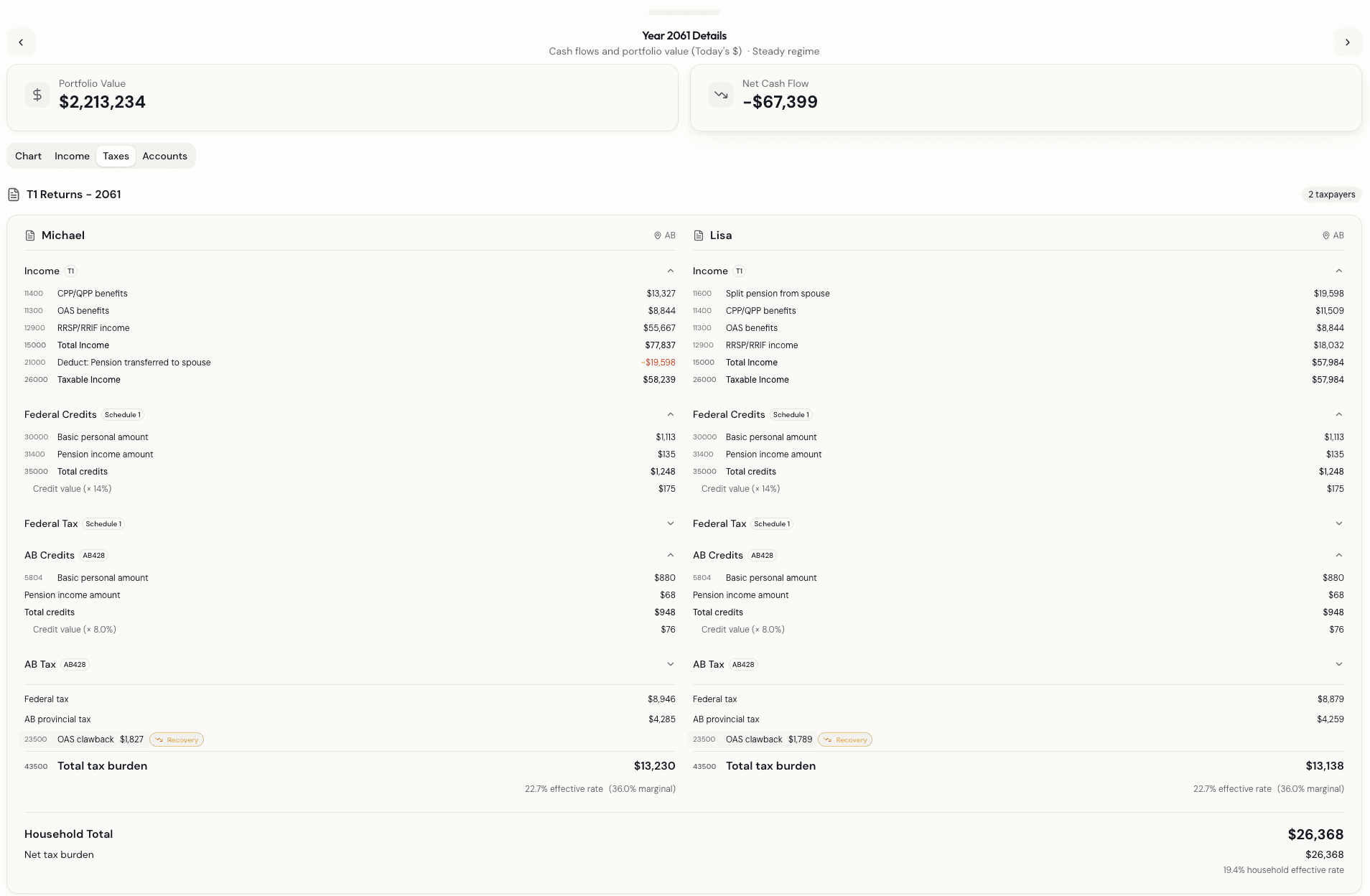
Your retirement plan includes a complete projected tax return for every year of your plan. Federal and provincial. Both household members. Income sources, deductions, non-refundable credits, refundable credits, and total tax burden — every line mapped to a real CRA form number so you can verify the math against your actual T1.
You can't optimize what you can't see. Now you can see it.
RRSP vs. TFSA: see the real difference for your situation
The textbook answer is “RRSP if your marginal rate is higher now than in retirement, TFSA otherwise.” But nobody knows their future marginal rate. It depends on when you start CPP, how much pension income you have, whether you split it with your spouse, and what province you live in.
We model both options across your entire timeline. You see the tax savings today, the tax cost at withdrawal, and the net difference — not in theory, but for your specific situation. We also track your contribution room for both accounts so you never accidentally over-contribute.
The right answer is different for every Canadian. That's why you need a tool that knows your numbers, not a blog post that guesses them.
Hundreds of credits. Calculated automatically.
Basic personal amount. Age amount. Pension income amount. Spousal amount. Disability tax credit. Canada Workers Benefit. GST/HST credit. Ontario Trillium Benefit. Quebec Solidarity Tax Credit. Every province has its own set of credits with its own phase-out thresholds.
We calculate every applicable credit for every year of your plan, in every province. You don't need to know the rules. When the rules change — and they change every year — we update. Dividend gross-ups, capital gains inclusion rates, deemed dispositions, spousal rollovers — all handled automatically. It's the same math that powers our free tax calculator.
You shouldn't need an accountant to understand how your own taxes work.
Pension income splitting and OAS clawback avoidance
Pension income splitting can save couples thousands per year in retirement. But the math is complex: it depends on both spouses' income, the type of pension, provincial tax rates, and whether the split pushes either spouse into a different bracket or triggers OAS clawback.
Pension income splitting is modelled automatically — you'll see the optimal split. We flag when your income approaches the OAS clawback threshold and shows strategies to stay below it — including how TFSA withdrawals (tax-free) compare to RRIF withdrawals (taxable) for managing your net income.
“What does a $10K RRSP contribution actually save me?”
You get a number, not a rule of thumb. The calculator applies your actual marginal rate for your province and income, runs the right federal and provincial credits, and shows the dollar impact on your return — the same engine behind every projection in the app.
Your numbers. Not a blog post written for someone in a different province.
$99/year Free for 2026.
Calculators and learning content are free. The planning app is free through 2026, then $99/year per household.
Reserve Your Place In Line