Capital Gains Tax Calculator
Calculate the tax you owe on investment gains in Canada. Enter your purchase and sale details, or just the gain amount, and see exactly how much goes to tax.
tl;dr
In Canada, only the taxable portion of a capital gain — set by the federal inclusion rate — is added to your taxable income. That portion is then taxed at your marginal rate. Federal and provincial tax are calculated separately, so the calculator works out the exact tax for your income and province.
Capital Gains Tax Calculator
Enter your purchase and sale details, then click Calculate to see a detailed breakdown of your federal and provincial capital gains tax.
Broker, legal, agent fees
Employment, interest, rental, etc.
Net capital losses from prior years
For a more detailed tax calculation with CPP, CPP2, EI, deductions, and credits, use the Visual Tax Calculator.
Example: Selling a Rental Property
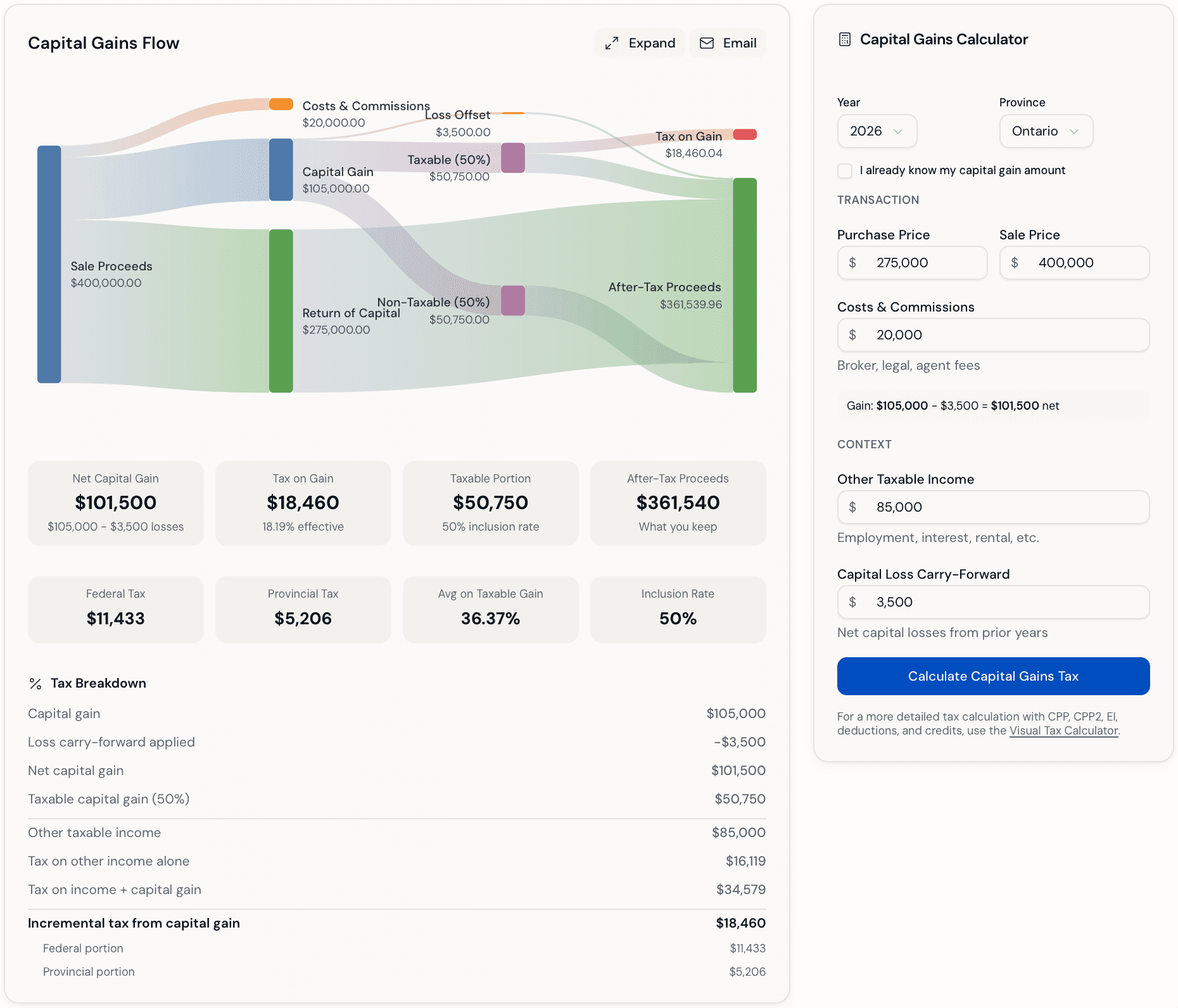
Bob lives in Ontario and earns $85,000 a year. He bought a rental condo for $275,000 and just sold it for $400,000. His real estate agent charged 5% ($20,000) in commission. Two years ago, Bob lost money on a cryptocurrency investment and has a $3,500 capital loss carry-forward he can apply against this gain.
Applying the carry-forward loss reduced Bob's taxable gain, which lowers the tax he owes — worth tracking even small losses. Because only part of a gain is taxable, the tax is a fraction of the full gain. Enter your own numbers above to see the exact tax, federal and provincial breakdown, and after-tax proceeds.
Capital Gains Tax by Province / Territory
You might also be interested in...
Related calculators that complement your financial planning
Visual Canadian Tax Calculator
Visual Personal Tax Calculator
Free 2026 Canadian tax calculator. Calculate income tax by province with interactive Sankey diagrams, deductions, and credits.
TFSA vs RRSP Calculator
Tax-Efficient Investment Strategy
Free TFSA vs RRSP calculator. Compare after-tax returns with refund reinvestment for Canadian savers. Find which account maximizes your retirement savings.
Canada-wide Tax Comparison
All Provinces & Territories
Compare take-home pay across all Canadian provinces and territories. Interactive map shows net income after taxes, CPP, and EI.
Why Capital Gains Tax Matters
Capital gains tax affects every Canadian who sells investments, real estate beyond their principal residence, or cryptocurrency. Unlike employment income, only part of a capital gain is taxable, which makes it one of the more tax-efficient forms of income in Canada. Even so, many investors are caught off guard at tax time because a gain stacks on top of their other income and can push them into a higher bracket. Understanding the tax helps you decide when to sell, whether to harvest losses to offset gains, and whether to realize gains in lower-income years. For real estate investors, capital gains tax is often the largest cost of a sale; for active investors, it affects the net return on every profitable trade.
How Capital Gains Tax Is Calculated
Capital gains tax in Canada follows a specific process that differs from regular income:
- 1. Calculate Your Gain: Capital gain = proceeds of sale − adjusted cost base − selling costs (commissions, legal fees).
- 2. Apply the Inclusion Rate: Only the taxable portion of the gain, set by the federal inclusion rate, is added to your income. The calculator applies the current rate automatically.
- 3. Add to Taxable Income: The taxable portion stacks on your other income (employment, business, etc.) for the year.
- 4. Tax at Your Marginal Rate: Federal and provincial tax are calculated separately on that income and added together — there is no single combined rate. The calculator shows the result for your province.
- 5. Offset With Losses: Capital losses offset capital gains in the current year, the previous three years, or carried forward indefinitely — a powerful planning tool.
What's NOT a Capital Gain?
Several common financial events do not trigger capital gains tax in Canada:
- ✕Principal Residence Exemption (PRE) — The sale of your home is fully exempt if it was your principal residence for every year you owned it.
- ✕Gains Inside TFSA / RRSP — Investment growth in registered accounts is tax-sheltered. TFSA gains are never taxed; RRSP gains are taxed as income on withdrawal.
- ✕Lottery & Gambling Winnings — Windfalls from lotteries, casinos, and gambling are not taxable in Canada.
- ✕Gifts & Inheritances Received — The recipient does not have a gain. A taxable disposition may occur for the giver or the estate of the deceased.
- ✕Life Insurance Proceeds — Death benefit payouts to beneficiaries are generally not taxable income.
Common Capital Gains Scenarios
Selling stock on top of a salary
You earn employment income and sell stock for a gain.
Only the taxable portion of the gain is added to your income and taxed at your marginal rate, so the tax is a fraction of the full gain. Enter your gain and salary above for the exact figure.
Selling a rental property
You sell an investment property (not your principal residence) for a gain after costs.
A large one-time gain can push part of your income into a higher bracket. The calculator shows the tax owing and after-tax proceeds in your province.
Selling cryptocurrency
You dispose of crypto for more than your adjusted cost base.
The CRA treats crypto like other capital property — only the taxable portion is taxed, at your marginal rate. Enter the gain above to see what you owe.
What To Do After Calculating Your Capital Gains Tax
- ✓Set Aside Tax Money: Put aside the estimated tax as soon as you realize a gain — the bill comes when you file your return.
- ✓Consider Tax-Loss Harvesting: Selling losing investments before year-end can offset your gains and reduce tax owing.
- ✓Watch Installment Requirements: If you owe enough tax, the CRA may require quarterly installments to avoid interest — check your situation.
- ✓Use RRSP Room: RRSP contributions reduce the income your gain stacks onto, lowering your marginal rate.
- ✓Plan Future Sales: When you have flexibility, spreading large gains across years can keep you in lower brackets.
- ✓Keep Detailed Records: Track your adjusted cost base (ACB) and keep purchase, sale, and cost records for several years.
- ✓Get Advice for Complex Cases: Real estate development, deemed dispositions, and business-income questions warrant a tax professional.
Common Questions
How are capital gains taxed in Canada?
In Canada, only the taxable portion of a capital gain (set by the federal inclusion rate) is added to your taxable income, then taxed at your marginal rate. Because only part of the gain is taxable, your effective rate on the full gain is well below your marginal rate. The calculator works out the exact tax for your gain, income, and province.
How does the capital gains inclusion rate work?
The inclusion rate is the portion of a capital gain that's added to your taxable income — the rest isn't taxed. It applies to gains on stocks, bonds, real estate other than your principal residence, cryptocurrency, and other capital property. The calculator applies the current inclusion rate automatically when you enter a gain.
How do I calculate my capital gain?
Your capital gain equals the sale price minus the adjusted cost base (ACB) minus any selling expenses. The ACB is typically your purchase price plus acquisition costs (legal fees, commissions). Selling expenses include broker commissions, legal fees, and real estate agent commissions. If the result is negative, you have a capital loss instead.
What is NOT a capital gain in Canada?
Several common financial events are NOT capital gains: (1) Selling your principal residence is exempt under the Principal Residence Exemption. (2) Gains inside a TFSA or RRSP are tax-sheltered. (3) Lottery and gambling winnings are not taxable. (4) Receiving a gift or inheritance does not trigger a capital gain for the recipient. (5) Life insurance proceeds are not taxable to the beneficiary. The person who gives a gift or the estate of a deceased person may have a deemed disposition, however.
Is selling my home a capital gain?
If the property is your principal residence and you lived in it for every year you owned it, the entire gain is exempt under the Principal Residence Exemption (PRE). You designate it as your principal residence on your tax return using Form T2091. If you only lived there for part of the ownership period or earned rental income from it, a portion of the gain may be taxable. Each family unit can designate only one property per year as their principal residence.
Are gains in my TFSA or RRSP taxable?
No. Investment gains (including capital gains) inside a TFSA are completely tax-free — both while invested and when withdrawn. RRSP gains are tax-deferred: you don't pay tax on gains while invested, but all withdrawals are taxed as regular income (not as capital gains). This means RRSP withdrawals lose the capital-gains advantage. For assets expected to generate large capital gains, a TFSA may be more tax-efficient than an RRSP.
Can I use capital losses to reduce my taxes?
Yes. Capital losses can only offset capital gains, not other income. If your capital losses exceed your gains in a year, the net capital loss can be carried back three years or carried forward indefinitely to offset gains in other years. You report both gains and losses on Schedule 3 of your T1 return. Superficial loss rules prevent claiming a loss if you repurchase the same security within 30 days.
What is the Lifetime Capital Gains Exemption (LCGE)?
The LCGE lets Canadian residents shelter a lifetime limit of capital gains on the sale of qualifying small business corporation shares, or qualified farm or fishing property. The limit is indexed annually and is a cumulative lifetime amount. It must be claimed on your tax return and requires the shares or property to meet specific conditions regarding Canadian-controlled private corporations or active farming/fishing use.
How is cryptocurrency taxed in Canada?
The CRA treats cryptocurrency as a commodity. Selling, trading, or converting crypto triggers a capital gain or loss (the difference between fair market value at disposition and your ACB). Trading one crypto for another is also a taxable disposition. If you mine or trade crypto as a business, gains may be taxed as business income (fully taxable) rather than capital gains (only partly taxable). The CRA weighs factors like frequency, intention, and volume of trading.
When do I report capital gains to the CRA?
You report capital gains in the tax year the disposition (sale, gift, or deemed disposition) occurs, on Schedule 3 of your T1 return. Your brokerage typically provides a T5008 slip showing proceeds of disposition, but you are responsible for tracking your adjusted cost base. The filing deadline is April 30 (or June 15 for self-employed individuals), but any tax owing is due April 30.
Does the province I live in affect my capital gains tax?
Yes. The inclusion rate is set federally, but the marginal rate applied to your taxable gain depends on your province — federal and provincial tax are calculated separately and added together, never as a single combined rate. Lower-rate provinces (Alberta, Saskatchewan, the territories) mean less tax on a gain; higher-rate provinces (Nova Scotia, Newfoundland, Ontario, Quebec) mean more. The province you reside in on December 31 sets your provincial rate for the entire year.
What are some strategies to minimize capital gains tax?
Common strategies include: (1) Holding investments in a TFSA where gains are tax-free. (2) Tax-loss harvesting — selling losers to offset gains. (3) Timing sales to low-income years. (4) Donating appreciated securities to charity (no capital gains tax plus a donation credit). (5) Using the principal residence exemption for your home. (6) Claiming the LCGE on qualifying small business shares. (7) Splitting gains across tax years when possible.